Rising tariff rates and a lack of centralized, asset-level monitoring prevent companies from identifying the specific sources of their energy consumption. Without real-time visibility, businesses only see costs on their monthly bills, making it difficult to maintain consistent operational standards or detect machinery faults, leaks, and abnormal waste early.
Additionally, at the 2023 COP28 summit, nearly 200 nations entered a historic pact to double the worldwide rate of annual energy efficiency improvements by 2030; however, real-world progress toward this metric has conversely decelerated (IEA, Energy Management for Industry, Executive Summary).
This creates pressure to meet Vision 2030, ESG, and Net Zero commitments, which is why implementing an Energy Management System in Saudi Arabia is an operational necessity, which is exactly where IoTech Energy comes in as we deliver clear, data-driven saving solutions.
Understanding Energy Management Systems in Saudi Arabia
In the Saudi Arabian commercial sector, many businesses manage utilities by relying solely on the single utility bill received at the end of the month. This traditional method lacks visibility into where, when, and why power is being consumed, making it highly difficult to identify operational inefficiencies or maintain consistent operating standards across different machines, production lines, and operational shifts.
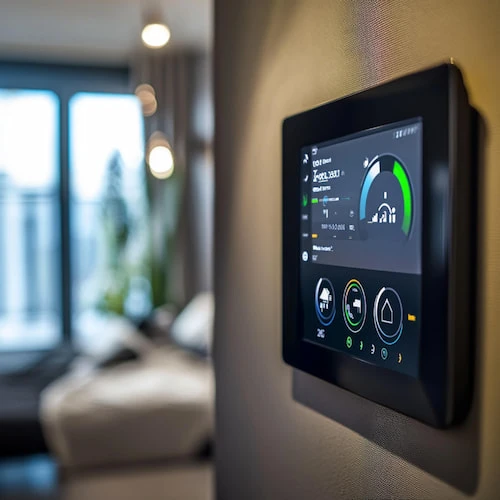
And here is where Energy Management Systems in Saudi Arabia come in handy, as an Energy Management System (EMS) is an integrated technology framework designed to provide real-time energy monitoring, asset tracking, and smart automation and control across commercial and industrial facilities.
Data from the Executive Summary of the International Energy Agency (IEA) report, Energy Management for Industry, shows that structured energy management in industrial companies delivers an average of more than 10% energy savings within the first three years of implementation.
How Energy Management Systems Work
A modern energy monitoring system Saudi Arabia operates via a continuous, cloud-connected cycle that transforms raw electrical currents into actionable corporate savings, and to help you understand this process, IoTech Energy structures the technical deployment across three distinct, continuous stages:
Eniscope EMS Hubs & CTs:
Compact Eniscope hardware hubs and current transformers (CTs) are integrated directly into the facility's primary distribution boards to bypass general utility measurements and track specific sub-circuits and individual asset-level metrics.
AI Analytics & Cloud Processing:
Collected infrastructure data is securely transmitted via a localized LoRaWAN network to a central Smart Cloud With API platform featuring SMART Analytics, AI Reporting, and real-time dashboards managed by IoTech Energy.
The system uses a Virtual Energy Manager to monitor operations, detect idle running machines, and identify inefficiencies based on real meter data.
Automated & Manual Control:
The platform acts as a digital checkpoint, as it triggers predictive alerts and alarms if a critical machine begins to fail, while simultaneously utilizing intelligent smart controllers to optimize asset scheduling automatically.
Why Saudi Companies Are Investing in EMS Solutions
The rapid adoption of the energy saving system KSA market is driven by distinct operational pressures. Saudi companies choose to invest in these advanced digital architectures to address several critical economic factors:
Protecting Net Margins Against Tariffs:
With expanding facilities and rising commercial power rates, unoptimized machinery can inflate operational bills,and implementing a Smart facility management through IoTech Energy framework allows companies to reduce electricity cost structures systematically.
National Compliance Standards:
The drive toward Saudi Vision 2030, ESG, and national Net Zero commitments has continuously tightened consumption baselines for commercial and industrial structures. Implementing a framework through IoTech Energy provides the transparent data trails required to demonstrate corporate compliance, which we fully deliver.
Asset Breakdown Prevention:
A lack of asset-level visibility prevents early detection of faults, leaks, and abnormal energy use. A smart framework flags hidden electrical irregularities long before a machine completely breaks down, protecting machine lifespans.
Advanced Features of Smart Energy Management Systems
High-performance platforms deployed by IoTech Energy utilize an array of multi-utility tools to optimize facilities, and we equip our users with the following advanced capabilities:
Comprehensive Multi-Utility Tracking:
Advanced setups do not stop at electricity, as the framework links standalone hardware meters, including Electricity, Water, and Gas, into a single building energy software web dashboard to expose hidden resource waste across all your corporate utility bills.
Wireless Environmental IoT Sensors:
Modern systems link directly with wireless "Air Sense" environmental sensors. These units track real-time occupancy, ambient room temperatures, humidity levels, and indoor carbon dioxide (CO2) levels, ensuring that energy-heavy climate control assets adjust dynamically based on live conditions.
Intelligent Three-Phase Asset Controllers:
Using specialized "Air Digital" smart control components, facilities can enforce strict automated scheduling for heavy three-phase assets, keeping machinery from being left running idly between shifts or during non-operating hours.
Top Benefits of Energy Saving Systems in KSA
Using energy efficiently lowers the total power needed to sustain economic growth. In rapidly expanding economies, these efficiency gains free up power grid capacity, directly improving living standards by making energy services more accessible to more people (IEA, Energy Savings). When partnering with IoTech Energy to introduce smart building solutions KSA frameworks, businesses experience immediate advantages that directly impact performance. :
Immediate Overhead Reduction:
Eliminates out-of-hours energy waste and detects idle running machines, typically delivering substantial reductions based on real meter data.
Extended Equipment Lifespans:
Monitors load distribution and asset health to maintain machine lifespan, reducing wear and tear on motors.
Real-World Local Validation:
Major regional brands operating in the Kingdom already see results. For instance, restaurant giant Kudu has active smart energy management solutions deployed by IoTech Energy across more than 30 stores where we achieved a verified 15% annual energy saving per store, a 53,571 kWh annual reduction, and a rapid 1.6-year payback period.
Industries Benefiting Most from EMS Solutions
Different sectors face unique operational waste patterns depending on their primary machinery and daily business schedules. To show how customized tracking solves these issues, IoTech Energy provides tailored IoT energy solutions across several major sectors:
Quick Service Restaurants and Food Retail:
High energy strains from constant commercial refrigeration, HVAC, and cooking equipment make food retail ideal for EMS, as asset-level monitoring pinpoints hidden leaks and ensures equipment efficiency across multi-site chains without compromising food safety.
Hotels:
Hotels often lose up to 29% of purchased energy. Advanced EMS platforms eliminate this waste by combining real-time consumption tracking with environmental indicators (temperature, humidity, occupancy), lowering costs while maintaining guest comfort.
Education:
Campuses feature diverse facilities operating on highly variable schedules. An intelligent EMS provides the structural visibility needed to eliminate waste during weekends, holidays, and off-peak hours by aligning energy use with actual occupancy.
Commercial Multi-Site and Retail:
Fragmented utility bills across widespread commercial portfolios offer no actionable insight. Centralized IoT systems consolidate real-time data across hundreds of locations, allowing enterprises to deploy automated efficiency strategies and track carbon reduction.
Manufacturing Facilities:
Manufacturing plants typically waste 21% of the energy they purchase. Advanced EMS platforms expose this avoidable waste by tracking heavy machinery at the individual asset level, driving down high utility costs while proactively preventing equipment failures.
IoT-Based Energy Management Systems in Saudi Arabia
The integration of IoT energy solutions utilizes a LoRaWAN hardware network alongside cloud-based energy optimization software. By deploying wireless, localized control units like Air Digital and Air Sense, we monitor localized parameters and automate equipment scheduling to coordinate complex site ecosystems.
Wireless hardware units, including Air Sense and Air Digital, track localized parameters like temperature and handle asset scheduling. These units communicate via the network with the central cloud dashboard, enabling the Virtual Energy Manager service to monitor operations around the clock, analyze data, and identify inefficiencies
Traditional Monitoring vs Smart EMS: What’s the Difference?
When evaluating your facility tracking options, the architectural and financial differences compare as follows:
Action & Workflow:
Traditional monitoring is passive and reactive, recording past events for human review, whereas a Smart EMS is proactive and automated, analyzing data in real time to adjust equipment automatically and save money.
Asset Coordination:
Traditional setups measure individual consumption points but depend on manual adjustments, while a Smart EMS coordinates complex site ecosystems, including solar, batteries, EV chargers, and HVAC, to maximize total efficiency.
Cost Saving Mechanism:
Traditional systems identify waste areas to help launch broad energy-saving campaigns, whereas a Smart EMS trims peak demand, avoids high electricity rates, and reduces operating costs dynamically.
Data Scope:
Traditional monitoring provides basic raw data like total electricity and gas consumed over periods, while a Smart EMS uses granular, minute-level data to benchmark, forecast, and generate compliance reports.
Choosing the Best EMS Company in Saudi Arabia
When selecting a partner to handle your commercial energy management needs and secure your utility savings, IoTech Energy stands out as the premier choice across Saudi Arabia because we combine established local experience with world-class technology:
Proven Local Track Record:
Proven Local Track Record: We have been a leading provider of building automation Saudi Arabia frameworks since 2015, bringing 9 years of technical expertise, a dedicated team of 75 IT professionals, 8 industries covered, and 145 successful success stories.
Fast and Non-Disruptive Installation:
Our certified technical teams complete the Eniscope hardware and CTs installation in just 3 hours without requiring any facility downtime or power interruptions.
Flexible Financial Models (EmaaS):
We offer an OpEx (EmaaS) model featuring zero upfront cost, IOTech asset ownership, included maintenance in the service, a fixed monthly service fee, and immediate savings with a cash flow impact that is positive from the first month.
24/7 Expert Management:
The system operates alongside our Virtual Energy Manager service and a 24/7 service level agreement (SLA) where analysts monitor operations around the clock to track real-world meter data.
Conclusion
By deploying an advanced, IoT-driven Energy Management System in Saudi Arabia, Saudi companies can gain total transparency over their utility spend, insulate their bottom line from rising operational costs, and actively support the Kingdom's sustainability vision.
We invite you to visit our website, explore our advanced internet-connected technologies, review our customized resource solutions, and discover how we optimize energy footprints across various sectors.
Don’t forget to contact us and book a consultation to make your business’ energy visible, controllable and easy to manage.
FAQs
What is an EMS system?
An EMS (Energy Management System) is an integrated solution combining non-disruptive hardware sub-meters and cloud-based analytics software.
It continuously tracks, analyzes, and controls utility consumption across specific circuits and individual machine assets.
How does EMS reduce electricity costs?
An EMS reduces costs by identifying hidden operational waste, such as machinery running idly outside of working shifts, failing refrigeration units drawing excess current, or unoptimized HVAC scheduling.
It provides real-time data and automated controls to optimize asset schedules and eliminate power waste.
What industries use EMS in Saudi Arabia?
An EMS Saudi Arabia is highly beneficial for any energy-intensive commercial sector, including restaurants, food retail, multi-site commercial, hotels, education, and light manufacturing plants.
What is the difference between EMS and BMS?
A Building Management System (BMS) automates and controls a facility's physical infrastructure, like HVAC, lighting, and security, to ensure comfort and safety. An Energy Management System (EMS) tracks energy usage and provides the data-driven insights needed to cut costs, maximize efficiency, and meet sustainability goals.

